Filter words in writing
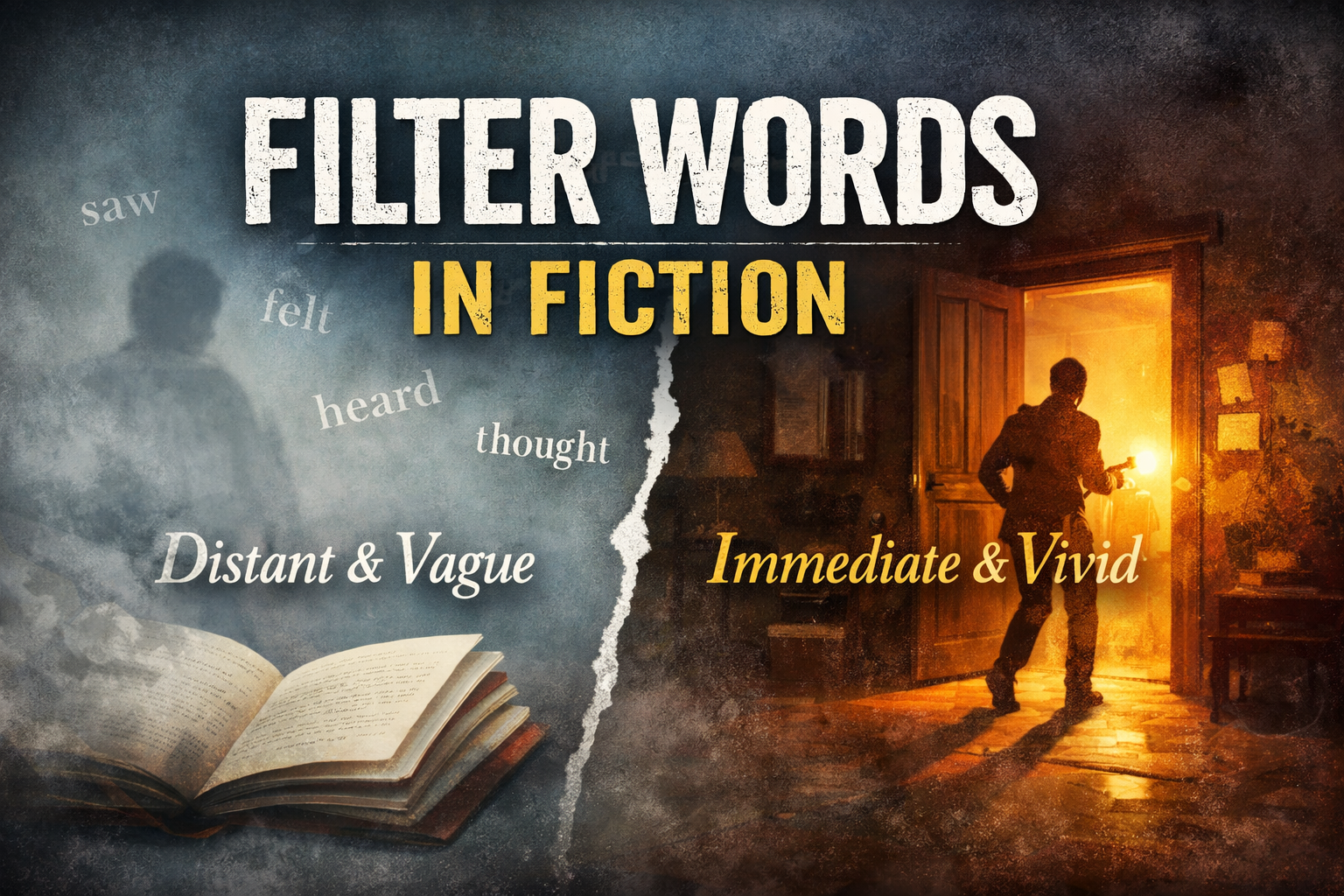
Filter Words in Fiction: The Invisible Barrier Between Story and Reader
There’s a particular kind of word in fiction that does its damage quietly. It doesn’t clang or clash. It doesn’t announce itself as clumsy prose. In fact, most writers use these words constantly—often without noticing.
They are filter words, and once you learn to spot them, you’ll begin to see just how often they stand between your reader and your story.
What Are Filter Words?
Filter words are verbs that describe a character perceiving something rather than simply presenting the experience to the reader.
Common examples include:
- saw
- heard
- felt
- noticed
- realised
- thought
- wondered
- seemed
At first glance, these words appear harmless. After all, characters do see and hear and think. The problem lies in how these words function on the page.
They insert an unnecessary layer between the reader and the action.
The Problem: Distance
Consider the difference:
She heard a door slam downstairs.
Now compare:
A door slammed downstairs.
The second version is more immediate. The reader experiences the sound as the character does, without being told about the act of hearing.
Filter words create narrative distance. They remind the reader that they are observing a character who is, in turn, observing the world. It’s the literary equivalent of watching events through a slightly smudged window.
For a writer aiming at immersion, that’s not ideal.
The Problem: Telling Instead of Showing
Filter words often drag prose into the territory of “telling.”
He felt scared.
This informs the reader of the emotion, but it doesn’t evoke it.
Now consider:
His pulse hammered against his ribs.
No filter. No abstraction. The reader experiences the fear through physical sensation.
The second example doesn’t just communicate emotion—it creates it.
The Problem: Sluggish Prose
Filter words also have a subtle but cumulative effect on pacing. They add extra words, extra structure, and extra processing.
She noticed that the sky was turning grey.
Becomes:
The sky turned grey.
Cleaner. Faster. Sharper.
Over the course of a chapter—or a novel—this difference becomes significant.
How to Spot Filter Words
The simplest method is also the most mechanical: search for them.
During editing, scan your manuscript for:
- felt
- saw
- heard
- thought
- realised
- noticed
You’ll likely find more than you expect.
But don’t blindly delete them. The goal isn’t eradication—it’s precision.
How to Remove Filter Words (and What to Write Instead)
1. Present the Experience Directly
Instead of filtering perception through the character, describe what they experience.
Filtered:
He saw the lights flicker.
Stronger:
The lights flickered.
2. Translate Emotion into Sensation
Replace abstract emotional labels with concrete detail.
Filtered:
She felt nervous.
Stronger:
Her fingers drummed against her leg.
3. Replace Thought Filters with Direct Thought
Filtered:
He thought the place looked abandoned.
Stronger:
The place looked abandoned.
Or, if you want voice:
This place is abandoned.
4. Let Dialogue and Action Carry Meaning
Filtered:
She heard him shout her name.
Stronger:
“Sarah!” he shouted.
5. Use Specific Detail Instead of General Perception
Filtered:
He noticed how beautiful she was.
Stronger:
Sunlight caught in her hair, and he forgot what he was about to say.
When Filter Words Are Useful
Like most rules in writing, this one isn’t absolute.
Filter words can be useful when you want distance or subjectivity.
For example:
-
To emphasise confusion:
He thought he heard footsteps behind him.
-
To control point of view:
She noticed something the others missed.
- To slow pacing deliberately.
The key is intention. Use filter words when they serve the narrative—not by default.
A Practical Rule of Thumb
If removing the filter word doesn’t change the meaning of the sentence, it probably doesn’t belong there.
Final Thought
Filter words are not dramatic offenders. They won’t ruin a sentence on their own. But they accumulate, quietly dulling the immediacy and power of your prose.
Strip them away, and something interesting happens:
the story stops being reported—and starts being experienced.
And that, after all, is the point.