How to Plan a Historical Novel: Structures, Tools, and Examples
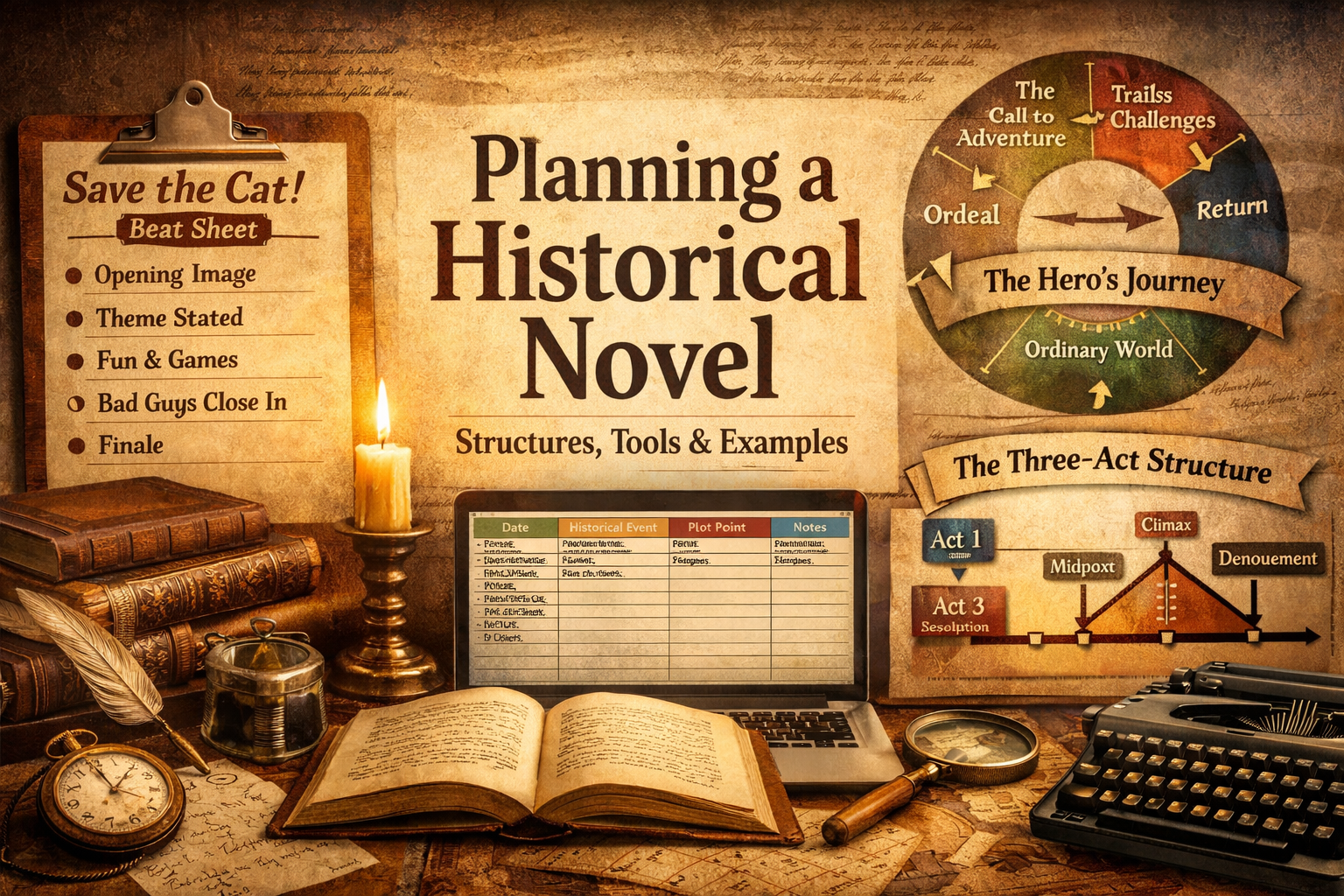
Writing historical fiction is a bit like staging a play in a world that no longer exists. You must balance rigorous research, dramatic pacing, and narrative clarity — all while honoring real events and real people. One of the most effective ways to do this is by choosing a solid narrative structure early in your planning. Below is a writing-blog guide to popular structural systems (Save the Cat, Three-Act, Hero’s Journey) and how to apply them to historical fiction, with practical charts and software approaches you can use — including Excel. Why Structure Matters in Historical Fiction Historical fiction risks losing readers if: The timeline is confusing. Too much exposition bogs down the plot. Characters lack clear arc or motivation. Using a narrative structure helps: Anchor your plot beats. Pace the story despite events that happened long ago. Shape character arcs and thematic resonance.
1. The Three-Act Structure: Classic Narrative Framework
Overview
-
Act I — Setup: Introduce world, context, protagonist, inciting incident.
-
Act II — Confrontation: Rising stakes, obstacles, midpoint reversal.
-
Act III — Resolution: Climax, resolution, denouement.
Historical Example
Hilary Mantel’s Wolf Hall: Act I introduces Thomas Cromwell’s early position in Tudor politics. Act II sees him rise amid turmoil and moral compromise. Act III resolves with his peak and eventual fall — a natural arc rooted in political history.
How to Plan It in Excel
| Sheet | Columns | Purpose |
|---|---|---|
| Timeline | Date / Event / Source Reference | Align historical events with plot beats |
| Act Breaks | Act I / Act II / Act III / Beat Notes | Flag narratively where key shifts occur |
| Characters | Name / Arc Start / Arc End / Motivations | Ensure each main character benefits from arc clarity |
Tip: Color-code cells to highlight pacing peaks and lulls, so that Act II doesn’t sag (a common historical novel issue).
2. Save The Cat! for Writers: Beat Sheet Approach
Overview
Blake Snyder’s Save the Cat! sequence offers 15 beats, such as:
-
Opening Image
-
Theme Stated
-
Fun & Games
-
Bad Guys Close In
-
Finale
Historical Example
Anthony Doerr’s All the Light We Cannot See follows a beat pattern where:
-
The Opening Image immerses readers in war-ravaged Europe.
-
The Fun & Games play out as characters search for meaning in chaos.
-
The Finale brings catharsis through interconnected resolution.
Software Tip
Use Notion or Trello to map each beat as a card:
-
Title: Beat Name
-
Content: Scene summary + historical anchor + character stakes
-
Labels: Timeline sync / tension level / sources needed
Then export to CSV and bring into Excel for timeline integration.
3. Hero’s Journey: Mythic Arc Meets History
Overview
Joseph Campbell’s “monomyth” includes:
-
Ordinary World
-
Call to Adventure
-
Trials & Temptations
-
Revelation / Ordeal
-
Return
Historical Example
Bernard Cornwell’s The Last Kingdom embodies this pattern:
-
Uhtred’s ordinary world (childhood)
-
His call to adventure (captured by Danes)
-
Trials across battles and alliances
-
Ordeal is his personal reconciliation with identity
-
Return as a reluctant but committed leader
Planning Technique
Create a Hero’s Journey Chart in Excel:
| Stage | Scene Summary | Historical Event | Dramatic Function |
|---|---|---|---|
| Call to Adventure | Uhtred taken by Danes | 9th c. Danish invasions | Disrupt equilibrium |
| Road of Trials | Campaigns in Mercia | 870s conflicts | Escalate stakes |
| etc. | … | … | … |
Link each cell to research sources or quotes — key for historical accuracy.
4. Software You Can Use (Beyond Excel)
Scrivener
-
Corkboard for scenes.
-
Assign labels by Act / Beat / POV.
-
Good for linking research documents.
Plottr
-
Visual timeline + character arc curves.
-
Exportable to Word / PDF when drafting begins.
Notion
-
Custom databases for events, characters, locations.
-
Sync timeline with writing tasks.
5. Integrating Structure with Historical Research
Historical fiction needs structure, but real events don’t always cooperate. Here’s how to reconcile that:
✔ Create a master timeline of real history first.
✔ Overlay your fictional plot beats on it.
✔ Use Excel filters like “Conflict Scenes,” “Romance Touchpoints,” “Turning Points” to balance pacing.
✔ Flag scenes where exposition outweighs action — then tighten.
Practical Excel Templates to Build
Master Timeline Sheet
| Year/Date | Real Event | Novel Event | Scene Number | Notes |
|---|
Beat Sheet Tracker
| Beat | Page Target | Actual Page | Tension Rating | Notes |
Character Arc Grid
| Character | Inciting Moment | Midpoint Shift | Climax Role | Resolution |
Final Thoughts
Planning a historical novel without structure is like navigating a country without a map. Whether you use:
-
Three Acts to anchor narrative balance,
-
Save the Cat! to ensure emotional pacing,
-
Hero’s Journey for mythic resonance,
…your story will benefit from a clear plan.
And by harnessing tools like Excel, Notion, Scrivener, or Plottr, you can merge historical fidelity with dramatic momentum — avoiding the twin pitfalls of dry exposition and aimless plotting.